In this article
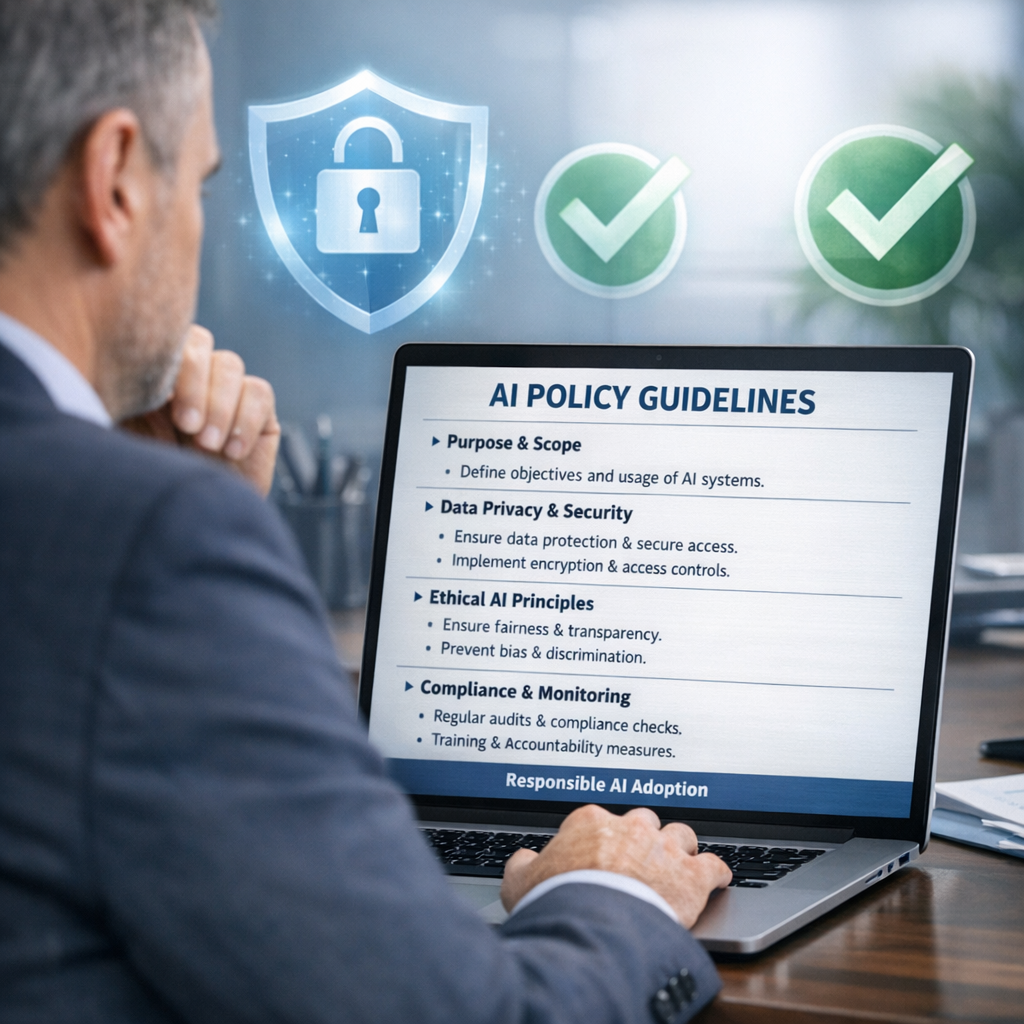
Without clear guardrails, AI tools can expose your organization to security gaps, compliance violations, and unintended data leakage—even when employees believe they're improving efficiency.
Why Your Business Needs an AI Acceptable Use Policy Now
Many organizations are watching employees adopt AI tools like ChatGPT, Gemini, and Microsoft Copilot without formal guidance. The assumption is that AI adoption is inevitable, so resistance is futile. The reality is different: without clear policy, these tools create security exposure most leadership teams haven't yet measured. Before assuming adoption is harmless, it's worth understanding whether employees can safely use ChatGPT, Copilot, and other AI tools at work.
Employees use AI to draft client communications, summarize contracts, analyze financial data, and generate code. In most cases, they're trying to work faster. What they may not realize is that data entered into public AI platforms can be stored, analyzed, and used to train future models. That includes Protected Health Information, client data subject to attorney-client privilege, financial records covered by SOX or GLBA, and proprietary business information. Understanding how generative AI creates data privacy risks for your business is an essential first step before allowing unmanaged AI use.
The 2025 Verizon Data Breach Investigations Report found that 68% of breaches involved a human element—phishing, credential theft, or social engineering. AI tools introduce a new category of human-driven risk: well-intentioned employees who inadvertently leak sensitive data through platforms they don't fully understand. For regulated industries—healthcare, legal, accounting, manufacturing—this isn't just a security problem. It's a compliance problem. Understanding AI security risks and controls for small businesses can help organizations address both dimensions of this challenge.
Cyber insurance carriers are now asking specific questions about AI governance during underwriting and renewal. Organizations without documented AI acceptable use policies may face higher premiums, coverage exclusions, or denied claims if a breach involves AI-assisted data leakage. An AI acceptable use policy isn't optional anymore. It's a business risk management requirement. To understand the full scope of what's required, explore what AI governance means for small and mid-sized businesses.
What an Effective AI Acceptable Use Policy Should Cover
An effective AI acceptable use policy establishes boundaries without eliminating productivity gains. The goal isn't to ban AI. The goal is to define how employees can use AI safely within the organization's risk tolerance and compliance obligations.
Start with scope. The policy should define what qualifies as an AI tool—public platforms like ChatGPT and Google Gemini, embedded features like Microsoft Copilot and its evolving capabilities and Grammarly, industry-specific applications with AI capabilities, and browser extensions that process or analyze content. If the tool uses machine learning to generate, summarize, or transform data, it falls within policy scope.
Next, define prohibited uses. Employees should not input Protected Health Information, personally identifiable information subject to HIPAA or GDPR, client data covered by attorney-client privilege or confidentiality agreements, financial data subject to SOX or GLBA, proprietary business information including trade secrets and strategic plans, authentication credentials or access tokens, or source code that could expose vulnerabilities. These prohibitions protect the organization from both data leakage and compliance violations.
The policy should specify approved AI tools and platforms. Not all AI tools handle data the same way. Microsoft Copilot for Microsoft 365, when properly configured, processes data within the organization's tenant and does not use that data to train public models. Public ChatGPT does not offer the same guarantees unless users specifically opt for enterprise agreements with data processing terms. Organizations should evaluate AI vendors the same way they evaluate any third-party service provider: through security questionnaires, data processing agreements, and compliance certifications.
Include employee responsibilities. Employees must understand that they are accountable for what they input into AI tools, what they do with AI-generated output, and how they verify accuracy before relying on AI-generated content. AI tools can generate plausible but incorrect information—sometimes called hallucinations. Employees should treat AI output as a draft that requires human review, not as authoritative final work product.
Address acceptable use cases. The policy should provide clarity on where AI can add value without creating risk. Acceptable uses might include drafting internal meeting agendas, generating ideas for marketing campaigns using publicly available information, summarizing publicly available research, or formatting and editing content that contains no sensitive data. These examples help employees understand what's encouraged, not just what's forbidden.
Finally, establish a process for requesting exceptions. Employees who believe they have a legitimate business need to use an AI tool not covered by policy should have a defined path to request review and approval. This process should involve IT, legal, and security leadership to evaluate risk and determine whether the tool can be added to the approved list with appropriate safeguards.
Security and Data Protection Requirements for AI Tools
Security controls for AI tools follow the same principles that govern any third-party application: visibility, access control, data protection, and monitoring. The difference is that AI tools process and generate content in ways that traditional applications do not, which requires additional scrutiny.
Start with visibility. IT and security teams need to know what AI tools employees are using. This requires network monitoring, endpoint visibility, and SaaS application discovery. Many organizations discover that employees have adopted dozens of AI tools without formal approval—a condition known as shadow IT. Without visibility, you cannot enforce policy or measure risk. Understanding why AI governance is becoming an operational discipline for SMB leaders can help frame the urgency of closing this visibility gap.
Access control is the next layer. Organizations should implement Zero Trust Network Access principles for AI tools just as they do for other applications. This means requiring Multi-Factor Authentication for all accounts, restricting access based on role and business need, and enforcing conditional access policies that block access from unmanaged devices or risky locations. For AI tools that process sensitive data, organizations may choose to restrict access entirely and provide approved alternatives.
Data protection requirements depend on what type of data the AI tool will process. If the tool will handle Protected Health Information, the vendor must sign a Business Associate Agreement that meets HIPAA requirements. If the tool will process payment card data, the vendor must demonstrate PCI DSS compliance. If the tool will store data in specific geographic regions to meet GDPR requirements, the data processing agreement must specify those commitments. These are not optional negotiations. They are legal and regulatory requirements.
Encryption is non-negotiable. Data should be encrypted in transit using TLS 1.2 or higher and encrypted at rest using AES-256 or equivalent. Organizations should verify that AI vendors meet these standards before approving tools for use. Many public AI platforms do not provide encryption at rest for free-tier accounts, which is another reason to require enterprise agreements for business use.
Monitoring and logging provide accountability. Organizations should log AI tool usage the same way they log access to other business applications. This includes who accessed the tool, when, and from what location. For higher-risk use cases, organizations may choose to implement Data Loss Prevention solutions that scan content before it reaches external AI platforms and block transmissions that contain sensitive data patterns such as Social Security numbers, credit card numbers, or medical record numbers.
The good news is that improving AI security posture does not always require major disruption. Many organizations already have endpoint protection, network monitoring, and SaaS management tools in place. The task is to extend those capabilities to cover AI tools and ensure that security teams have visibility into what's being used and how data flows.
Compliance Considerations When Employees Use AI
For regulated industries, AI adoption without compliance oversight creates audit risk, regulatory penalties, and potential liability. Healthcare organizations subject to HIPAA, legal practices bound by attorney-client privilege, accounting firms managing SOX-regulated data, and manufacturers pursuing CMMC certification all face specific obligations that AI tools can violate if used improperly. Understanding the difference between AI security, AI governance, and AI compliance is essential for organizations navigating these overlapping requirements.
HIPAA compliance requires that any vendor or tool that processes Protected Health Information sign a Business Associate Agreement and implement safeguards to protect data confidentiality, integrity, and availability. Public AI tools that do not offer Business Associate Agreements cannot be used to process Protected Health Information. An employee who pastes patient data into ChatGPT to summarize medical records has created a HIPAA violation, even if the intent was to work more efficiently. Healthcare organizations looking for compliant solutions should understand what HIPAA-compliant managed security services require before deploying any AI tools.
Legal and accounting firms face similar constraints. Attorney-client privilege requires that client communications and case information remain confidential. Using AI tools to draft legal briefs or analyze discovery documents without ensuring that the tool meets confidentiality standards can waive privilege. The same principle applies to accountants who handle financial data subject to SOX or GLBA. If the AI vendor does not meet the same security and confidentiality standards the firm would apply to any other third-party service provider, the tool should not be used. Legal professionals should review the security checklist every legal professional should follow to ensure AI tools meet their ethical and compliance obligations.
Manufacturers pursuing CMMC certification must demonstrate that Controlled Unclassified Information is protected according to NIST SP 800-171 requirements. AI tools that process or store CUI must meet the same access control, encryption, and audit logging requirements that apply to other systems in scope for CMMC. Using a public AI tool to analyze technical drawings or contract specifications could disqualify the organization from certification if the tool does not meet CMMC requirements. Manufacturers should understand what CMMC compliance requires and where to start before allowing AI tools anywhere near CUI.
Regulatory and compliance expectations continue to evolve. The Federal Trade Commission has issued guidance on AI transparency and bias. The European Union's AI Act establishes risk-based requirements for AI systems. State-level privacy laws in California, Virginia, and Colorado create obligations around automated decision-making. Organizations that operate in multiple jurisdictions need to understand how these regulations intersect with their AI use cases.
This is where Compliance as a Service becomes valuable. Organizations that lack internal compliance expertise can work with a vCISO or compliance partner to map AI tools to regulatory obligations, establish controls that meet audit requirements, and document policies in a way that satisfies regulators and cyber insurance carriers. Compliance is not a one-time checklist. It's an ongoing program that adapts as technology and regulations change.
How to Implement and Enforce Your AI Policy
A policy that employees don't understand or cannot follow will not reduce risk. Implementation requires clear communication, accessible training, technical enforcement, and leadership accountability.
Start with communication. Employees need to understand why the policy exists, what it requires, and how it affects their daily work. The communication should emphasize that the policy is designed to protect the organization and its clients, not to punish employees for trying to work efficiently. Frame AI governance as a business risk management issue, not an IT restriction. Leaders looking for a structured approach to this conversation can benefit from a leadership playbook for AI adoption in SMBs.
Training is the next step. Employees should receive specific examples of acceptable and prohibited AI use cases relevant to their roles. A healthcare provider should learn why pasting patient names into ChatGPT violates HIPAA. An accountant should understand why using AI to summarize tax returns creates SOX compliance risk. A manufacturing employee should know why uploading technical drawings to a public AI platform could disqualify the company from defense contracts. Training should be role-based, scenario-driven, and repeated regularly—not a one-time event. Organizations looking to build this kind of ongoing capability can explore strategies for improving your team's skills and performance as a foundation.
Technical enforcement ensures that policy is not solely dependent on employee judgment. Organizations should implement Data Loss Prevention solutions that block transmissions containing sensitive data patterns before they reach external AI platforms. Network monitoring should flag AI tool usage that falls outside approved applications. Endpoint protection should prevent installation of unapproved browser extensions and applications. These controls create guardrails that reduce the likelihood of accidental violations.
Access control is another enforcement mechanism. Organizations can restrict access to approved AI tools based on role and business need. Employees who do not have a legitimate reason to use AI for their job function should not have access. For employees who do need AI capabilities, access should be granted through enterprise agreements with approved vendors that meet security and compliance requirements.
Leadership accountability matters. Executives and managers should model appropriate AI use and reinforce policy expectations. When employees see leadership taking shortcuts or ignoring policy, they will do the same. Conversely, when leadership consistently follows policy and discusses AI governance in business meetings, employees understand that the policy is a priority.
Enforcement should include consequences for violations. The policy should specify what happens if an employee uses AI in a way that violates policy—whether that's additional training, restricted access, or disciplinary action depending on severity. The goal is not to create a punitive environment but to establish accountability. Employees need to understand that policy violations create real risk for the organization and its clients.
Finally, treat the policy as a living document. AI technology evolves rapidly. New tools emerge. Vendors change their data processing terms. Regulations are updated. The policy should be reviewed and updated at least annually, or more frequently if significant changes occur in the AI landscape or regulatory environment. Organizations should establish a cross-functional AI governance committee that includes IT, legal, compliance, and business leadership to oversee policy updates and address emerging issues. Understanding why most SMB AI initiatives fail—and how to fix them can help organizations build the structural foundation needed to sustain AI governance over time.
If you're not sure where your organization currently stands with AI governance, start with a structured risk assessment. Identify what AI tools are in use, what data they process, and what compliance obligations apply. From there, you can build a policy that reflects your actual risk profile and operational needs. That's the difference between reacting to AI adoption after a breach and managing AI as part of a broader business risk strategy. A good starting point is understanding how to conduct a cybersecurity risk assessment for your SMB to establish the baseline visibility you need.

Join the conversation
Have a question or a different take on this? Add it below.